RTF Surface Jointmeter
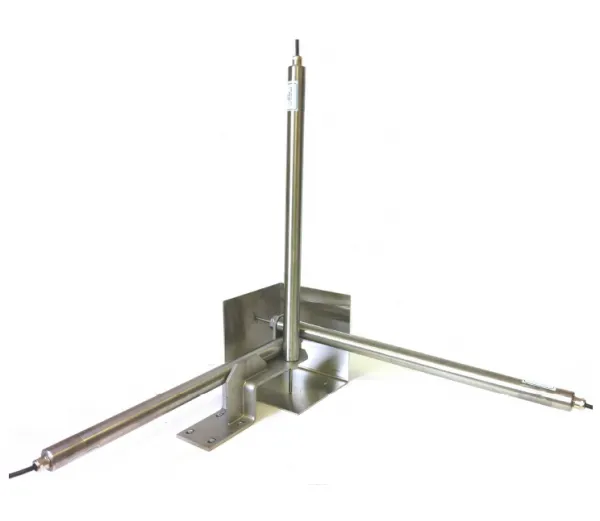
The RTF surface jointmeter (also called a crackmeter or fissurometer) measures relative movement across cracks or construction joints in rock masses and structures, with a vibrating-wire or potentiometer transducer available in uniaxial (1D) or triaxial (3D) versions.
- Range
- 25-200 mm (vibrating wire, model dependent); 25-150 mm (potentiometer)
- Accuracy
- ±0.25% F.S. vibrating wire (±0.1% optional); ±0.5% F.S. potentiometer
- Resolution
- 0.02% F.S. (vibrating wire)
Overview
In detail
How it works
A spring-loaded rod bridges the crack or joint, with a bracket holding the transducer(s) mounted on one side of the discontinuity and a bracket fitted with a reference surface mounted on the opposite side. The spherical tip of the rod rests against the reference surface, so relative movement between the two brackets is measured as displacement.
Sensor options
A vibrating-wire transducer offers ranges of 25, 50, 100, 150 or 200 mm, ±0.25% F.S. accuracy (±0.1% optional) and 0.02% F.S. resolution. A potentiometer transducer offers ranges of 25, 50, 100 or 150 mm at ±0.5% F.S. accuracy, with resolution depending on the readout instrument used.
Deployment
The unit is bolted directly astride the joint or crack. The RTF 1D version measures a single axis, while the RTF 3D version measures three orthogonal directions simultaneously (available for the vibrating-wire type in the 25-150 mm range).
Reach out and say hi
Specifications
Technical specifications
- Range
- 25-200 mm (vibrating wire, model dependent); 25-150 mm (potentiometer)
- Accuracy
- ±0.25% F.S. vibrating wire (±0.1% optional); ±0.5% F.S. potentiometer
- Resolution
- 0.02% F.S. (vibrating wire)
- Operating temperature
- -20 to +80 °C
- Versions
- RTF 1D (uniaxial), RTF 3D (triaxial)
Related
Often specified alongside
ESS Earth
Resistance Wire Extensometer RWE
- Application
- Underground hard rock and coal mine displacement monitoring
- Monitoring points
- Pillars, stope walls, roof
Geosystems
JM Series Vibrating Wire Jointmeter
- Range
- 25, 50, 100, 150, 200, 250, 300 mm (200/250/300 mm not available for JM-E)
- Accuracy
Ready to specify?
Add RTF Surface Jointmeter to your enquiry
Build a list, add your site notes, and an ESS engineer will quote the lot — cables, mounting and calibration included.