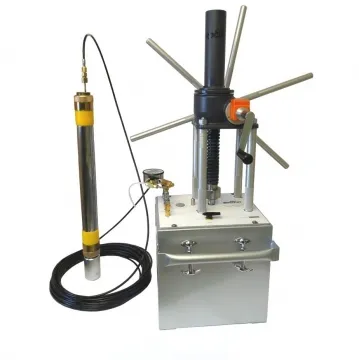
DMP Borehole Dilatometer
The DMP Borehole Dilatometer is a probe for determining the in-situ modulus of deformation of rock masses. It loads the borehole wall in progressive steps via an inflatable membrane and measures the resulting diametrical deformation.
- Range
- 25 mm (3 pairs of inductive displacement sensors)
- Weight
- 45 kg
- Outer diameter
- 95 mm
Overview
In detail
How it works
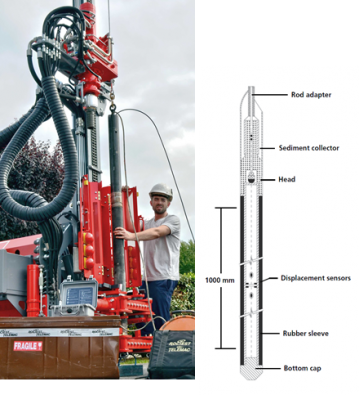
The probe has a metal central body fitted with an inflatable rubber membrane carrying three pairs of metallic inserts spaced at 120° intervals, held by a split spring-ring and double-cone retaining system. Three pairs of inductive displacement sensors (two measurement points each) track the membrane's diametrical deformation, while a pressure sensor measures the inflation pressure. The membrane is inflated with compressed dry gas (nitrogen or air), and the test loads the ground in progressive steps to measure the resulting deformation.
A sediment collector sits on top of the probe with a threaded end for connection to the rod string.
Deployment
The probe is lowered into the borehole on a string of rods. Two membrane types are available: a standard 'HR' high-strength membrane for hard rock, and an 'A' low-strength membrane for soft rock.
Measurement
The test generates a modulus of initial loading, elastic moduli measured on cyclic loadings, a creep phase, and the anisotropic behaviour of the rock mass.
Reach out and say hi
Specifications
Technical specifications
- Weight
- 45 kg
- Outer diameter
- 95 mm
- Membrane (sleeve) length
- 1000 mm
- Membrane types
- 'HR' high strength (hard rock); 'A' low strength (soft rock)
- Range
- 25 mm (3 pairs of inductive displacement sensors)
- Displacement resolution
- 1 μm
- Displacement accuracy
- ± 25 μm
- Max working pressure
- 20,000 kPa
- Pressure resolution
- 10 kPa
- Pressure accuracy
- 0.1% F.S.
Related
Often specified alongside
Geosystems
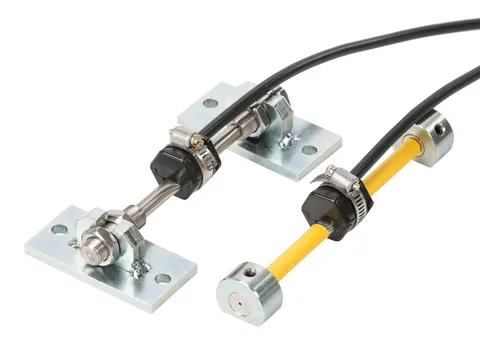
Vibrating Wire Strain Gauge SM-5
- Range
- 3000 µε
- Accuracy
- +/- 0.5% F.S.
- Temp
- −20 to +80°C
- Range
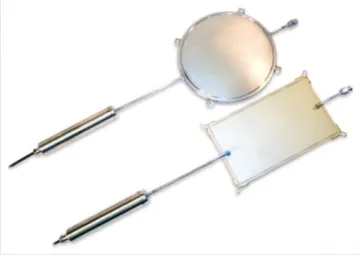
- 200 to 35,000 kPa (standard steps up to 35,000 kPa)
Ready to specify?
Add DMP Borehole Dilatometer to your enquiry
Build a list, add your site notes, and an ESS engineer will quote the lot — cables, mounting and calibration included.