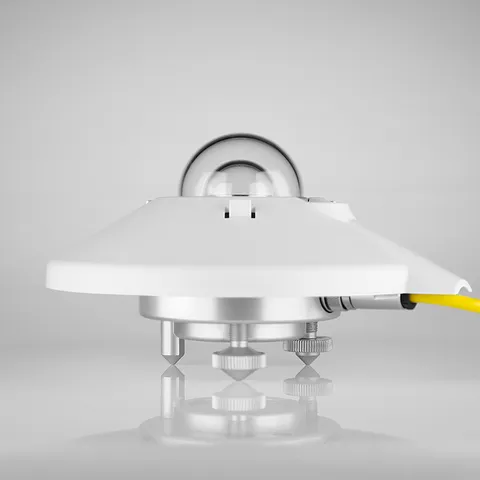
CMP11 Albedometer ISO 9060:1990 Secondary Standard
The CMP11 Albedometer Kit is a step up in performance from the CMP11 kit and is recommended for scientific applications where accuracy needs to be to the highest standards. It complies with the highest level of ISO 9060:1990 classification, Secondary Standard, and comprises two Kipp & Zonen pyranometers with sun shields and mounting plates supplied.
- ISO 9060:1990 classification
- Secondary Standard
- Response time (95%)
- < 5 s
- Non-linearity (0 to 1000 W/m²)
- < 0.2%
Overview
In detail
Measurement
This ISO 9060:1990 Class A albedometer kit is ideal for defining the ratio of irradiance reflected to irradiance received by a surface (albedo). This results in a scale from 0 (no reflection) to 1 (total reflection).
Configurations
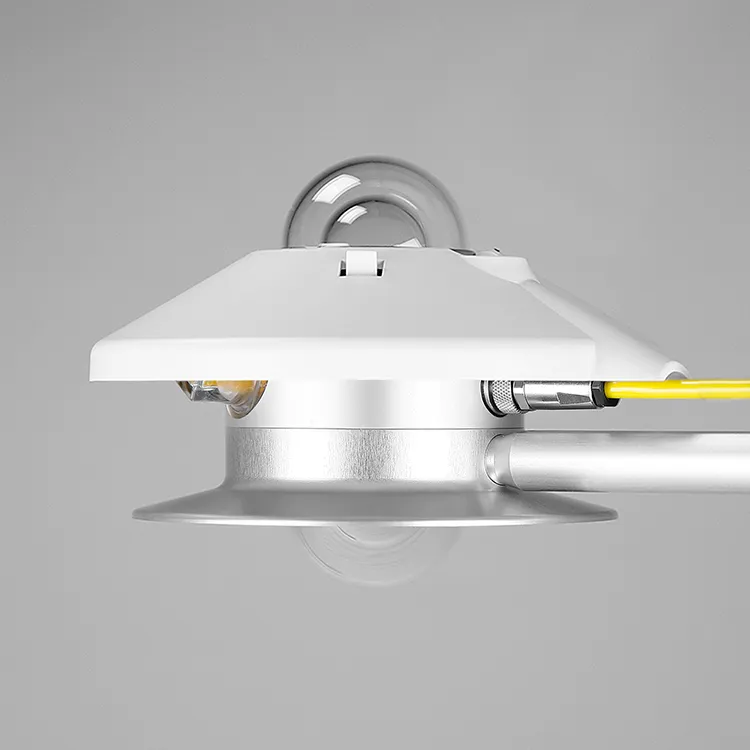
By using two separate pyranometers with a mounting fixture (plate and rod) and a glare screen for the lower pyranometer, there is a choice of configurations available.
The CMB1 mounting bracket can be used to fix the rod to a pole or wall.
If the CMF1 mounting fixture is replaced by the CMF4 model, the CVF4 ventilation unit can be used with the upper and/or lower pyranometers. For the lower CVF4 a special glare screen is available.
Applications
Its good quality and cost-effectiveness make the CMP11 albedometer kit ideal for meteorology, hydrology and agricultural applications.
How an albedometer measures
An albedometer consists of two pyranometers. The upper sensor measures incoming global solar radiation and the lower sensor measures solar radiation reflected from the surface below. When the two signal outputs have been converted to irradiance in W/m², the albedo can be simply calculated. As an indication, albedo is about 0.15 for grass, 0.5 for dry sand and 0.8 for fresh snow. A glare screen prevents direct radiation reaching the lower detector when the sun is low.
Bifacial PV
Bifacial PV modules generate extra power from light on the rear side that is primarily reflected from the surface below. This varies with the type of surface, weather conditions, angle of the sun and shading effects, making it necessary to measure how the albedo of the surface changes. For this use the albedometer is mounted low, around 1.5 m, and does not need a lower glare screen.
Specifications
Technical specifications
- ISO 9060:1990 classification
- Secondary Standard
- Response time (95%)
- < 5 s
- Non-linearity (0 to 1000 W/m²)
- < 0.2%
- Tilt error (at 1000 W/m²)
- < 0.2%
- Temperature dependence of sensitivity
- < 1% (-10 °C to +40 °C)
- Sensitivity
- 7 to 14 µV/W/m²
- Impedance
- 10 to 100 Ω
- Spectral range (50% points)
- 285 to 2800 nm
- Maximum irradiance
- 4000 W/m²
- Directional error (up to 80° with 1000 W/m² beam)
- < 10 W/m²
Related
Often specified alongside
Weathertech
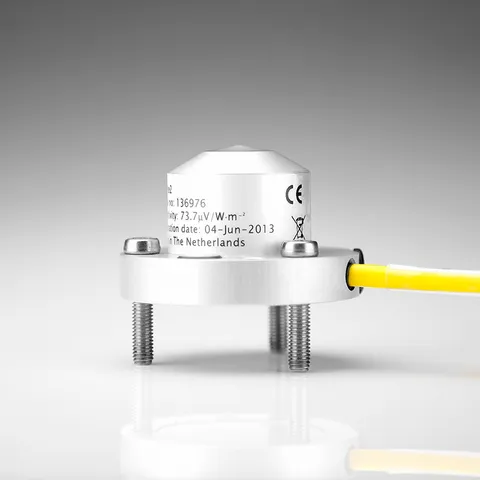
SP Lite2 Pyranometer
- Temp
- -40 °C to +80 °C
- Spectral range (overall)
- 400 to 1100 nm
- Sensitivity
- 60 to 100 µV/W/m²
SMP6Weathertech
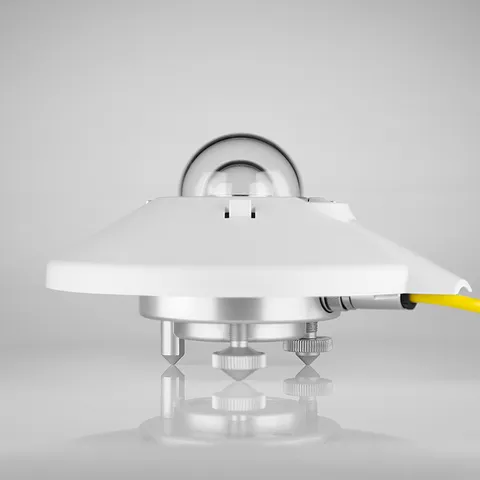
SMP6 Pyranometer
- Supply
- 5 to 30 VDC
Ready to specify?
Add the CMP11 to your enquiry
Build a list, add your site notes, and an ESS engineer will quote the lot — cables, mounting and calibration included.